
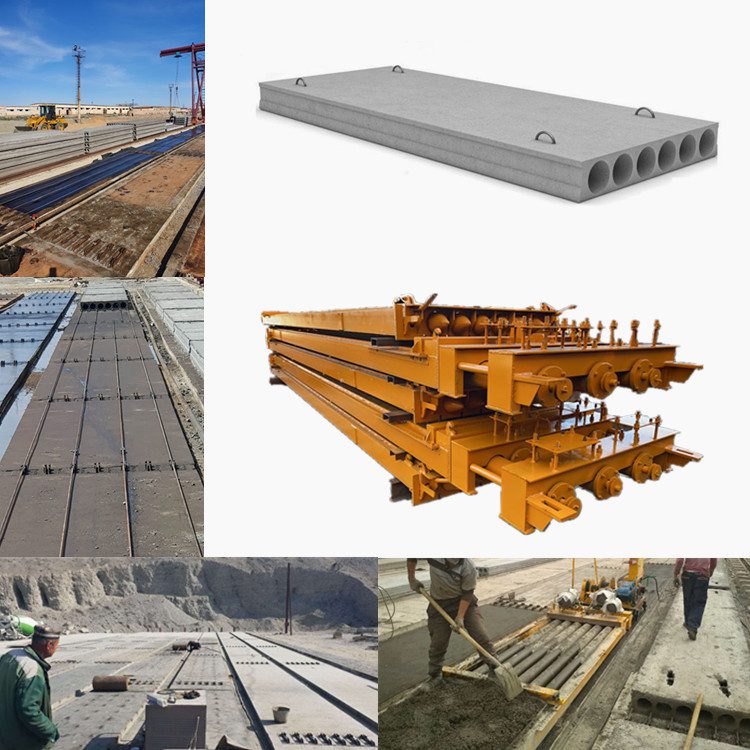
Concrete Floor Slab Machine: Efficient Production for Modern Construction
A concrete floor slab machine is a specialized mechanical equipment designed for producing high-quality precast concrete floor slabs. Widely used in residential, commercial, and industrial construction projects, this machine transforms traditional on-site casting into a fully automated factory-based process, improving efficiency, reducing material waste, and ensuring consistent quality.
Working Principle of Concrete Floor Slab Machine
The working principle of a concrete floor slab machine involves several key steps:
- Material Preparation
Cement, sand, gravel, water, and additives are mixed in precise proportions to create a uniform concrete mixture. This ensures consistent quality across all produced slabs. - Mold Arrangement and Reinforcement Placement
The concrete is poured into pre-designed molds, which can be horizontal or vertical depending on the machine model. Expansion joints, holes, or cable channels are pre-installed if necessary. Steel mesh or prestressed bars are arranged in the molds to enhance bending strength and durability. - Concrete Filling and Molding
The machine automatically feeds the concrete mixture into the molds. Compacting is achieved through vibration, extrusion, or rolling methods:
- Vibration compaction: High-frequency vibrators ensure the concrete fills every mold cavity, eliminating air pockets.
- Extrusion molding: Forces concrete into shape under high pressure, ideal for large-span prestressed slabs.
- Rolling molding: Uses rollers to evenly distribute and compact concrete for smooth, dense slabs.
- Curing and Demolding
After molding, slabs are sent to curing chambers or natural curing areas. Steam or controlled humidity accelerates hardening. Once the concrete reaches sufficient strength, slabs are demolded automatically. - Post-Processing
Some machines include cutting devices to trim slabs to precise dimensions. Surface finishing, polishing, or coating can also be applied before stacking and transporting the slabs to the construction site.
Key Features of Concrete Floor Slab Machines
- High Efficiency: Batch production allows factories to produce large numbers of slabs in a single day, reducing construction timelines.
- Reliable Quality: Automated processes ensure dimensional accuracy, dense structure, and high-strength slabs resistant to cracking or deformation.
- Material Saving: Precise control reduces concrete consumption without compromising slab strength.
- Easy Operation: User-friendly interface requires minimal operators, reducing manual skill demands.
- Versatility: Capable of producing slabs in various shapes, sizes, and designs to meet diverse architectural requirements.
- Technical Parameters: Machines differ in plate height, width, number and diameter of hollow cores, production speed, main motor power, and vibrator specifications. For example, a common model may have a plate height of 12 cm, width of 50 cm, speed ≥1.1 m/min, and a 4 kW motor.
Applications of Concrete Floor Slab Machines
- Residential Buildings
Precast floor slabs provide stable structural support. Hollow-core designs also improve thermal and sound insulation, enhancing living comfort. - Commercial Buildings
In shopping malls, hotels, and office complexes, precast slabs allow rapid large-area floor installation, reducing construction time and labor costs. - Industrial Buildings
Factories, warehouses, and large-span facilities require slabs with high load-bearing capacity. Concrete floor slab machines can produce large precast slabs to meet these requirements efficiently.
Maintenance Tips
To ensure long-term efficiency and performance of a concrete floor slab machine:
- Regular Inspection: Check vibrators, motors, reducers, and other key components to detect faults early.
- Consumable Replacement: Molds, bearings, and other wearing parts should be replaced or serviced regularly to maintain production quality.
- Cleaning: Remove concrete residues and dust from the machine surfaces to prevent corrosion or equipment damage.
- Lubrication and Calibration: Ensure moving parts are properly lubricated and calibrated for consistent slab quality.
Conclusion
A concrete floor slab machine is essential for modern construction, enabling rapid, high-quality, and cost-effective production of precast floor slabs. With features like automated molding, precise vibration compaction, and versatile post-processing, these machines support residential, commercial, and industrial projects while reducing labor and material costs. Regular maintenance and monitoring of vulnerable components ensure long-term operational efficiency, making concrete floor slab machines a cornerstone of industrialized construction.
Henan Kelai Industrial Co., Ltd. provides you with high-quality products and professional services, and looks forward to cooperating with you.If you need any information, please contact us !

 English
  Arabic
  French
  Russian
  Spanish
  Portuguese
  Turkish