

Working Principle of Concrete Hollow Slab Mold Making Machine and Prestressed Hollow Core Slab Machine
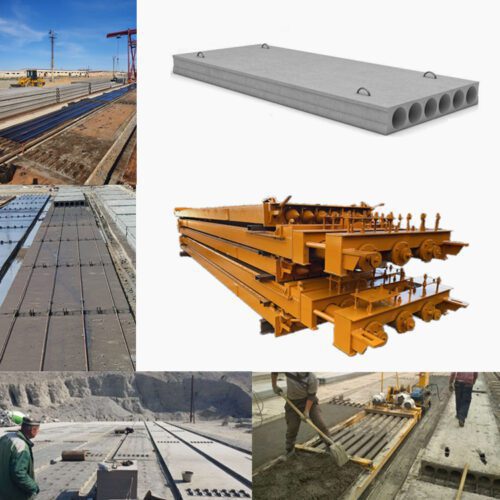
In modern construction, Concrete hollow slab mold making machines and Prestressed hollow core slab machines are essential for producing precast floor slabs efficiently and with high structural quality. These machines are widely used in large-scale industrialized construction projects, providing standardized, durable, and cost-effective floor solutions. Their working principles include concrete molding, steel reinforcement placement, vibration compaction, prestressing, curing, and demoulding. Here’s a detailed explanation of their workflow and key technologies.
1. Material Preparation
The production process starts with preparing a uniform concrete mixture. Cement, sand, gravel, water, and various additives are mixed according to the designed proportion. The quality and consistency of the concrete mixture are critical to ensure the final slab meets structural requirements, whether it is a hollow slab, prestressed slab, or composite slab.
2. Mold Arrangement and Preparation
The molds for precast slabs can be arranged horizontally or vertically depending on production needs:
- Horizontal molds: Common for standard slabs; allow easier vibration and compaction.
- Vertical molds: Suitable for long or specialized slabs; concrete is pumped and compacted vertically.
For hollow slabs, core molds or inflatable pipes are placed in the molds to create voids, reducing weight while maintaining strength. Expansion joints, cable troughs, and other design features are also pre-installed.
Reinforcement Placement: Steel mesh or prestressed steel bars are arranged in the mold before concrete pouring. This step enhances bending resistance and tensile strength, ensuring the slab can handle large spans and heavy loads.
3. Concrete Filling and Molding
Feeding: Concrete is evenly delivered into the mold using automated feeding systems.
Compacting Methods:
- Vibration compaction: High-frequency vibrators ensure concrete fills the mold completely, eliminating air pockets.
- Extrusion molding: Concrete is pressed through an extrusion system, suitable for large-span prestressed hollow slabs.
- Rolling molding: Rollers compress the concrete for uniform density and smooth surfaces.
These methods ensure the slabs have consistent density, strength, and surface quality.
4. Prestressing Technology (If Applicable)
For Prestressed hollow core slab machines, steel bars are tensioned before concrete pouring. After molding, the prestressed steel enhances bending resistance and load-bearing capacity, making these slabs ideal for bridges, industrial floors, and multi-story buildings.
5. Curing and Demoulding
Curing: Once formed, slabs are sent to curing rooms. Steam or natural curing accelerates hardening and strengthens the concrete. Typical curing time ranges from 12 to 24 hours depending on slab thickness and environmental conditions.
Demoulding: After reaching the required strength, slabs are removed using automatic demoulding devices, reducing manual labor and preventing slab damage.
6. Post-Processing
- Cutting: Slabs are cut to the specified length and size using integrated cutting devices.
- Surface Treatment: Polishing, patching, or coating improves appearance and durability.
- Stacking and Transportation: Finished slabs are stacked neatly and transported to construction sites or storage areas.
Key Technologies and Advantages
- Mechanized Feeding and Forming: Ensures high production efficiency and uniform slab quality.
- Vibration and Extrusion Technology: Guarantees dense concrete, avoiding internal voids and defects.
- Prestressed Steel Bar Technology: Enhances bending strength for large-span floor slabs.
- Rapid Curing and Automatic Demoulding: Supports continuous, high-volume production.
Common Types of Concrete Hollow Slab Mold Making Machine
- Hollow Floor Slab Machine: Uses core molds or tubular inserts to leave hollow sections, reducing weight while maintaining structural integrity.
- Prestressed Hollow Core Slab Machine: Employs prestressed steel technology for long-span floor slabs, ideal for industrial and commercial construction.
- Composite Floor Slab Machine: Produces slabs with additional features such as insulation layers or reinforced composite structures for specialized applications.
Conclusion
Concrete hollow slab mold making machines and Prestressed hollow core slab machines are crucial for modern precast floor production. They provide high efficiency, standardized quality, and structural reliability, supporting industrialized construction projects worldwide. By integrating mechanized feeding, vibration/extrusion compaction, prestressing, and automated curing, these machines enable large-scale, cost-effective production of precast floors for residential, commercial, and industrial applications.
For high-quality, durable precast floor solutions, Henan Kelai Industrial Co., Ltd. offers advanced machinery that meets the demands of modern construction.

 English
  Arabic
  French
  Russian
  Spanish
  Portuguese
  Turkish